October 7, 2011

The Two-Bear Mambo ***

*** The Two-Bear Mambo, Joe R Lansdale, 1995 Disclaimer

I skimmed through the second Hap and Leonard novel, Mucho Mojo, and then dove into The Two-Bear Mambo on the ellipitcal. Every time I read a Hap and Leonard novel I think it can't get any more crazy, then the next one goes off the charts.

Grovertown, where much of the action takes place, is based on Vidor, which was notorious as a hotbed of racism and Klan action. I've been to Vidor a few times, and my college roommate, Fred Smith, was from Vidor, although he had not a racist bone in his body and was nicer that most people I know.

According to wikipedia, Vidor has cleaned up its act in the last few decades. But at the time Lansdale wrote this book, it was unregenerate and Grovertown is unimaginably brutal, far beyond what I imagine happened in Vidor in at least the past 50 years or longer.

Once again Lansdale brings us fantastic images and extended scenes of violence, interspersed with smartass, sarcastic dialog and startling metaphor. There were a few places where I felt the dialog became a bit on-the-nose and expositional. Especially when Charlie turns into a redneck psychologist at the end.

Like with McConnelly, in a Lansdale novel, nobody is safe. In fact, there were moments when I wondered if the main characters would survive, even though I know there are a half-dozen more books in the series.

September 29, 2011

A Monstrous Regiment of Women ***

*** A Monstrous Regiment of Women, Laurie R King, 1995

This should really be 3 and a half stars, but I can't do half an asterisk. I did skim through The Beekeeper's Apprentice to get back up to speed. It took a while because it was very difficult to avoid dipping back in and read instead of skim. But I got up to speed and proceeded to A Monstrous Regiment of Women.

For me the most fascinating thing about this book is that King actually made Christian theology an exciting element of the story. Really. Unbelievable, right? Well, she did it.

This book is a rollercoaster ride that really pushed the limits. Russell gets in over her head several times, quite beyond her depth, and finally it caught up with her. In my humble, but accurate, opinion, King does Doyle one or two better. And she takes a few humorous swipes at him in the book.

At the end, she confirmed something that I suspected when reading the prelude. I'll let you discover it for yourself.

It's on to A Letter to Mary. I'm quivering with anticipation.

September 22, 2011

Savage Season ***

*** Savage Season, Joe R. Lansdsale, 1990 Disclaimer

We're back on Lansdale, forging through the Hap and Leonard series. I read Mucho Mojo, the second in the series, on recommendation from Zane. As I said before, Lansdale is a brilliant writer. Vivid images, trenchant metaphors, visceral writing, penetrating characters, outrageous circumstances, sardonic humor.

But he also has a penchant for graphic violence, moderately explicit sex, and, the deal killer for me, a tendency to focus on the worst aspects of human nature, to roll around in the depravity of man like a hound dog in a cow pie. While I enjoyed the writing brilliance of his short-form work in Sanctified and Chicken Fried, I didn't like spending that much time in such a dark place. Although I must say that the last story, "White Mule, Spotted Pig" was transcendent.

So, I decided to avoid the other work for now and start at the beginning of the Hap and Leonard series and read them all, and then see what I thought. Like the other novels in the series, Savage Season has more sex per gallon than I prefer in a book. It has a closing showdown scene that goes on for about 30 or 40 amazing pages, with some seriously graphic violence. But it doesn't have the lingering malaise of moral despair.

Savage Season isn't a whodunit, it's a treasure hunt turned horrifyingly bad. It's also Lansdale in all his perverse glory. Give it a shot if it's the kind of thing you go for.

September 15, 2011

The Miraculous Journey of Edward Tulane ***

*** The Miraculous Journey of Edward Tulane, Kate DiCamillo, 2006

This was a Kindle Daily Deal book. Of course it's a kid's book, a story for children. It seemed a little stark in some places for a kid, but what do I know from kid's books?

Edward is the very definition of the passive protagonist, as he is a toy rabbit made of china and fur. He can't move or talk. All of the action in the book happens to him or around him, viewed through his thoughts.

But this is the way of some children's books, so I guess that's OK. He's a bit of a smug prig in the beginning, which I found amusing.

It's a nicely told story from the author of the Tale of Despereaux and Because of Winn Dixie. The illustrations by Bagram Ibatoullines are excellent.

EBOOK FORMATTING ***

The thing about ebooks.

No table of contents, embedded or otherwise, for the Kindle. However, the left/right keys do move you back or forward one chapter. The Nook sample I downloaded had a TOC. In all other respects, it is a nicely done ebook.

September 8, 2011

Back On Murder ****

**** Back On Murder, J. Mark Bertrand, 2010

Note: I started rating books online 20 years ago, before Amazon existed, and developed a 0 to 4 star system. Add a star to get an equivalent Amazon rating.

First off, note another four-star book. Not many of these in a year. You should get this and read it now.

I don't recall where I first ran across Mark - somewhere online about a decade ago when I was in Honolulu and he was in Houston. We exchanged some emails. I read a short story of his and was overwhelmed. At that point I knew I wanted to read anything this guy wrote.

But then life proceded as it does and now, many years later, I'm in Texas and he's in South Dakota and I discover that he's got a contract with Bethany House and a couple of books out in a series. I downloaded the sample on my Kindle, read it, and bought the thing right then. I had the discipline to finish the bedside book I was reading before picking up Back on Murder. As soon as I finished it, I bought the second one immediately. I'll read it when I finish a few other items in the stack.

Here are a few things that stood out for me:

  • "I let her take my hand a lead me up the back stairs All is not right in my world, but one small corner is about to get noticeably better."
  • "Her gaze has a soft and sightless quality, as if her eyes were the back of a silvered mirror."
  • There is this brooding backstory hanging just out of sight for a large portion of the novel. You know there's some point at which this is going to be laid out for you. Two-thirds of the way in, you get the story, but in tight dialog, not in a big information dump. Very deftly handled.

The bottom-line is, if you like well-written police crime fiction, you should read this book. It's not quite Michael Connelly, but it's pretty dang close. Kinda like E. F. Benson vs P. G. Wodehouse. Excellent characters, March, the homocide cop who is the protagonist, the various levels of the police department, the bad guys, all of them, very well drawn. The story has plenty of tendrils, some of which fade out and others which interwine at the end, to keep you guessing.

Connelly was a crime-beat reporter. I don't know that much about Bertrand, personally, but he seems to have a surprisingly intimate knowledge of police culture and processes for a guy with an MFA. Although there was one moment that bugged me. A cop comes to March, saying he'll give him important information in exchange for an immunity deal. They talk for a while, the cop insisting on a signed deal before he'll even mention what his information is about. As I know from my extensive experience in watching cop shows and reading crime novels, you can't get a deal without some sense of what it is you have to offer and a high degree of credibility that you can deliver. So the conversation doesn't feel authentic. Cause I know these things.

This book is published by Bethany House, which is a Christian publisher, but there is no three-points-and-a-poem, come-to-Jesus moment, for which I am grateful because I find them obnoxious and typically avoid Christian fiction for that reason. There are a few notable exceptions based on quality writing and lack of cheese factor. Bertrand is now on that very short list, along with Lisa Samson, Tosca Lee, Athol Dickson, and a few others.

There was only one spot, about a third of the way in, that I felt edged the line, when a cop who is religous gets provoked and says, “What do you believe, March? About God, the universe and everything?” Which is followed by 2 or 3 paragraphs of his response. The exchange felt gratuitous. Less than a page. Minor irritation that quickly passed.

EBOOK FORMATTING **

This is the first Kindle novel that I've reviewed. Having recently suffered through producing Kindle, Nook and iPad versions of the three Fred novels, paying painstaking attention to high-quality production, I'm painfully aware of bad formatting.

For a traditionally published book, the author has no control over production, so this is really a critique of the publisher and their epub production, which may or may not be outsourced.

In my humble but accurate opinion, if publishers want readers to spend $9.99 or more for an ebook, they should produce a superb quality ebook. I hired an experienced epub guy and did over a dozen proofreadings of all three versions of all three books to do everything possible to deliver them with the highest production quality, and with extras you don't get in the print books. And I'm just one guy, not a publisher. And the Fred ebooks are only $2.99. So I have little tolerance for significantly priced ebooks from major publishers, or anyone else, with poor production quality.

NAVIGATION

None. No table of contents, embedded or otherwise. No ability to skip between chapters using the right/left keys. So, if you want to skip back 7 or 8 chapters to check on something, you just have to scroll back one screen at a time, check it, and then scroll forward. Or play "guess the location" with the Go To button.

PARAGRAPHS

There are two ways of doing paragraphs:

  1. Indent the first line, no blank lines between paragraphs.
  2. Block style, no indent, a blank line between paragraphs.

This book does both, which wastes limited ereader screen space. Pick one is my motto.

In addition, like many print books, extra line spacing is used to indicate a scene change instead of some kind of graphic element. The problem is that with spacing between paragraphs, which doesn't normally occur in a print book, it's easy to overlook the extra space, which means you enter a new scene without realizing it and get disoriented. Not good to get knocked out of the story like that just from a lack of good formatting. I recommend some kind of graphic indication of scene change for all ebooks. Plus, it just looks nicer and doesn't cost extra to do.

PROOFREADING

I get the impression that proofreading is not as high priority for ebook production as it is for print. In this case, there is a paragraph that is right-justified with ragged left margins somewhere in there. There is also an occurence of a character's name that is hyphenated in the middle of a line, with spaces in the middle of the name, thus: Cav- allo. It's highly unlikely you would see either of these errors in a print book.

NOOK

I downloaded the Nook sample. You get the front matter and a couple of chapters. The paragraph formatting is done right, indents, no linespaces. There is both an embedded and physical table of contents, but the embedded TOC only covers the front matter and the first chapter. The physical TOC covers the whole book, but it doesn't work. Touching the links doesn't take you anywhere.

If I were Bertrand, I'd send Bethany house a copy of this review.

September 1, 2011

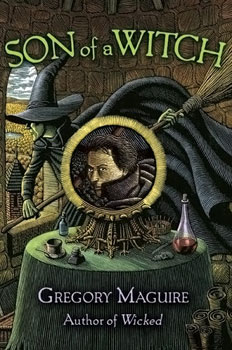
Son of a Witch ***

*** Son of a Witch, Gregory Maguire, 2005

I'm on a roll, reading lots of good books by good writers with a flare for imagery, a turn of phrase, and metaphor. It's been a while since I read Wicked, but I thought it was great, so when I saw the sequel at Half-Price books, I snagged it.
It does not disappoint. Excellent writing that pegged the Elliptical Test. I evidently read Wicked before 2008 when I started the Wunderfool Reading List, so I don't have a review to point to. The stories provide an alternate history of Oz and characters from the Frank L Baum series, which I've never read. Unlike Baum's books, Maguire's books are not for children and are definitely not rated G. I would put them more at an R rating.

But the writing is excellent and highly recommended.

August 25, 2011

The Sweetness at the Bottom of the Pie ****

**** The Sweetness at the Bottom of the Pie, Alan Bradley, 2010

Finally, after many months, we get a four-star book! The best description of this book is to imagine an 11-year-old Miss Marple. That pretty much says it all, and for those who like that sort of thing will love this.

For those not familiar with Miss Marple, we're talking about a classis whodunit set in the 1950 English countryside. The protagonist, 11-year-old chemical genius Flavia de Luce, finds a body in the cucumber patch and we're off and running. Flavia is a precocious narrator in the tradition of Scout (To Kill a Mockingbird) or Swede (Peace Like a River).

I stayed up until two and three AM on multiple occasions reading this book. This is Alan Bradley's first novel, published when he was 70. It may be his first novel, but this is definitely not his first rodeo. Some of the figures of speech spun my head around like a carousel.

I can't recommend it highly enough. I will definitely be following all of Flavia's adventures, several of which are already available.

August 18, 2011

Resurrection in May ***

*** Resurrection in May, Lisa Samson, 2010

The novel has been sitting on my shelf for some time like a fine wine as I was reluctant to precipitately imbibe the only extant Lisa Samson novel I haven't read and be left bereft. But I finally cracked it open and drank.

Here's the takeaway: If a book has Lisa Samson's name on the front, it's worth buying an reading. Period. I've read all her novels since The Church Ladies and haven't been disappointed once. (Well, there is that dark period where she wrote historical romances, but I don't talk about those.)

I have to admit Resurrection in May has not displaced my other favorites, the most recent being Embrace Me, but it's still got lots to recommend it. The Rwanda segment was vibrant and visceral and the ending, beginning with the prison visit, was powerful. And there is that spot that caught me completely off guard the way Embrace Me did. Wonderful stuff.

From a technical standpoint, I think this is the first contemporary novel Lisa has written in third person. I also found it an interesting choice to place almost half the book in the POV of Claudius, even though it is May's story. Person and POV decisions are sometimes very difficult, but they can make or break a story.

But enough of the inside baseball talk. If you haven't read this one, yet, then get to it. I hear she's got another in the works. Good thing, since I just depleted my stock.

August 11, 2011

The Throne of Fire ***

*** The Throne of Fire, Rick Riordan, 2011

Rick is on a roll. (Sorry, I couldn't resist it.) It amazes me that Riordan can do the formula for five Percy Jackson books and now two Kane books and still make it interesting.

I just wish I could get the newer ones autographed. I got the first three Percy Jacksons autographed, but that was before there was a movie and they had to move his appearances at the Texas Book Festival to the Paramount because of the crowds.

If you like mythology-based YA action adventure stories and haven't read Riordan, you absolutely need to stop what you're doing and check him out. While you're at it, check out his Tres Navarre detective novels, too. They're even better.

August 4, 2011

The Art of War **

** The Art of War, Sun Tzu, 512 B.C.

One advantage of getting a Kindle is you end up reading all the classics you've been putting off reading because you can get them for free. One downside of this practice is that the free versions tend to have poor formating. But hey, it's free.

One thing I learned in the (very long) introduction is that, like the Bible, The Art of War has had many translators with varying interpretations of problem passages. Lin Wusun's translation is interspersed with James Clavell's commentary, which offers alternate translations and illustrative anecdotes.

If I were a student of war, strategy and tactics, I would have found the multiple viewpoints interesting, but I'm not and I found they slowed down the reading. However, I did enjoy the anecdotes. Man, those ancient Chinese warriors were a crusty lot!

If you're into this type of thing, it's worth more stars. For me it's more of a curiousity than anything. Hmm, maybe I'll stream the Wesley Snipes movie of the same name.