-->
Showing posts with label ****. Show all posts

October 11, 2012

Angle of Investigation ****

**** Angle of Investigation, Michael Connelly, 2011


Somewhere along the way I discovered three Kindle-only collections of Bosch short stories, three stories each. A nice way to tide me over until The Black Box comes out next month.

This is classic Bosch, filling in some back story not covered in the novels. One is the case mentioned in a later novel of a killer being caught because of a hand print left over a toilet.

Great price, great stories for any Bosch fan.


July 12, 2012

Nothing to Hide ****

**** Nothing to Hide, J. Mark Bertrand, 2012
Third in the series after Back on Murder and Pattern of Wounds, Nothing to Hide stands out as Bertrand's best work, yet. Aging and beleaguered, Detective Roland March might actually be out on his ear this time.

An occasional bounce into March's 1986 career as an MP allows the reader to converge on the identities of two key players in the current story crime.

Reading the previous two reviews will quickly let you know that I consider Bertrand's Roland March series a must-read. I had only minor, insignificant quibbles with the first and no reservations about the second. I don't speak lightly when I say that if you like Connellys' Harry Bosch series, there's a very good chance you'll like Bertrand. I read a lot of whodunits and I can't think of another I would say that, with the possible exception of Riordan's Tres Navarre series.

Like Connelly, Bertrand holds nothing back. You can make no assumptions and no one is safe. You get the feeling he'll kill of March if it serves his purpose, or render him irrelevant. A writer like Bertrand can pick up with another protagonist and off we go again. Not that I'm suggesting I've had enough of March. Quite to the contrary.

I haven't asked Bertrand if he has any other March novels under contract because I'm afraid of hearing the wrong answer. But if there's any fairness in this world, and that's a highly dubious speculation, then we're in for many more years of Roland March goodness.

In the meantime, catch up. You don't want to be behind when the next one comes out.


June 28, 2012

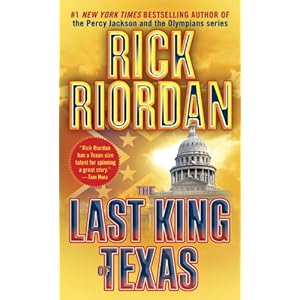
The Last King of Texas ****

**** The Last King of Texas, Rick Riordan, 2001

Although I think I've read everything Rick has written, to date I've only reviewed one other Tres Navarre novel, The Devil Went Down to Austin. Not for lack of love, but because when I was reading the other books, I wasn't writing reviews. I come back to The Last King of Texas pursuant to a character I'm developing for my next novel, a dealer in arcade and casino games for the greater southwest region. As it turns out, there's not a lot in common between my character, Buckworth, and Riordan's Del Brandon, carnival ride dealer down in San Antonio.

But any minute reading a Tres Navarre novel is not wasted, regardless the motivation or outcome. This is actually the first Riordan novel I ever read, having discovered it while living in Honolulu. I mean, how can you pass up a novel with this title? I immediately went back and got the first two and moved on from there.

I've had the chance to meet Riordan on three or four occasions, the first being when I took a half-day workshop he taught on writing a mystery novel, just before the first Percy Jackson book came out. Extremely nice guy.

I dare anyone to read the first chapter of this book and set it down and walk away. I can't imagine the person who could do such a thing. Well, there's my son-in-law, but nobody else. I would give you some quotable lines, but there are dozens in every chapter, so I lost track.

Look, forget all that. Just go out and get the dang book and read it. Okay?

Oh, and Rick, I know you're busy writing best-seller YA novels left and right, but hire someone to be-Kindle your Tres Navarre backlist. Just do it.

April 12, 2012

The Non-Designers Design Book ****

**** The Non-Designers Design Book, Robin Williams, 2008

I can't possibly say enough good things about this book. As a visual novice taking on the task of designing book interiors and marketing collateral for Wunderfool Press, this book rightly assumes I know nothing and goes from there.

If you're not sure whether it's worth picking up, go to the preview on Amazon and scroll down to page 12. If that doesn't sell you, then the book is not for you. Williams doesn't have that much to say about book design, neither covers nor interiors, but the principles she sets down are universal and the concepts are easily applied to any visual project that relies on type.

Here are a few of the basic rules of thumb Williams advocates:

  • Don't be a wimp.
  • Don't use 12-point type.
  • Don't use Times, Arial, Helvetica, or Sands.
  • Don't be a wimp.

I jest. But only a little. Each page of the book is a beautiful visual, and the content is simple and foundational. If you are a novice and have to do any layout at all, get this book!

February 6, 2012

Hunger Games ****

**** Hunger Games, Suzanne Collins, 2008

I've seen all the hype about Hunger Games for the past few years, but I tend to discount hype and I had plenty of things I needed to read, so I didn't bother to check it out. But I saw the trailer for the movie and thought perhaps I should check it out before the movie came out. I saw it was under $6 on the Kindle, so I grabbed it and read it in a weak moment.

Wow. That's all I can say. Wow. This is a rare case of the hype being justified.

I guess I can say a little more, but Wow. The writing is good from the start, but when the games begin it becomes almost impossible to put this thing down. And the final battle in the games, holy freaking cow! I understand this to be a YA book, but man is it gnarly. I'm not a fan of movie violence, so who knows if I'll do the movie or not. Probably. We shall see.

Bottom line: Worth the read.

***Spoiler alert***: There was one thing that bothered me about this book: How the protagonist doesn't snap to the fact that the romantic interest from the other tribute is sincere. It took her way to long to realize he was legit.

EBOOK FORMATTING ****

Why it matters.

The ebook version was flawless. Didn't see a single typo, formatting issue or navigation problem. I can't rate the next/last chapter navigation from the 5-way navigation pad because I upgraded to the Kindle Touch, which doesn't have any buttons. I kind of miss being able to skip forward or backward a chapter, and I miss being able to change the orientation to landscape, but other than that, love the Touch.

January 30, 2012

How To Lie With Statistics ****

**** How to Lie with Statistics, Darrell Huff, 1954

I read this book back in the 70s and loved it. Since it's been a while I thought I'd give it another read. Still good.

It's a lightweight course on how statistics can be used to misrepresent information. Even if math is not your strong suit, you can follow this book and learn how to find the weak spots in a statistic.

One downside is that all the examples are from the 1920s through the 1950s. For example, here's the beginning of Chapter 1:

"The average Yaleman Class of '24," Time magazine noted once, commenting on something in the New York Sun, "makes $25,111."

Well, good for him!

But, wait a minute. What does this impressive figure mean?

Even knowing we're talking about 1924, it's hard to see this as impressive. But eventually you adjust your head for a century back.

The other downside is that it doesn't take long for you to realize that you're never going to have enough information about any stat you see in a newspaper, magazine, TV show or the internet to know if it's legit.

But I can live with that.

January 16, 2012

The Weed That Strings the Hangman's Bag ****

**** The Weed That Strings the Hangman's Bag, Alan Bradley, 2010

I bought this a few months ago but have been saving it as a treat to myself. I picked it up during the week between Christmas and New Year and forced myself to only read a little at a time so it would last the whole week. I finished it on Dec 30, so I was almost successful.

The second Flavia de Luce novel is just as well written as the first one, but it takes a little longer to get to the crime, which doesn't happen until page 151. But Flavia is entertaining even when there is no dead body, so that doesn't put any marks against it in my book.

Time to get A Red Herring Without Mustard. Only one released after that one, so I need to take them slowly to reduce the gaps between books.

January 5, 2012

What Would Jesus Drink? ****

**** What Would Jesus Drink?, Brad Whittington, 2011

In 1996 I did a study of all the verses in the Bible that referred to wine and strong drink and it found its way to the Internet under a pseudonym. That essay was quoted in The Year of Living Biblically, was evidently the primary source material of a Relevant Magazine article, was credited by Michael Spencer (RIP) aka The Internet Monk in a 2005 posting, and referenced by dozens of other sites on the internet.

I recently decided to update the essay and released it as What Would Jesus Drink? I released it in digital form as a 99-cent ebook (the lowest price allowed) on Amazon and other outlets. I also made it available in paperback for those don't do ebooks, also priced as low as the system would allow, which comes out to $7.49. Amazing what going from electrons to paper can do to the price!

You can see the table of contents and read a chapter or so on Amazon. I have to say a big thanks to Hilary Combs for the beautiful front cover and Tosh McIntosh for the designing the rest of the cover and the interior of the book, a huge undertaking.

As I worked on this project, I read some of the books that surfaced in the intervening fifteen years. Most of these were not available when I did the original study, otherwise I probably would not have written my own.

In the next several weeks I'll review the books I read. I'll give you a little hint about what is to come. Most of them are against any kind of drinking, and the best book in that category was published in 1871. The anti-drinking book guys who have published in the last two decades could have learned a few things from Rev. William Patton.

September 8, 2011

Back On Murder ****

**** Back On Murder, J. Mark Bertrand, 2010

Note: I started rating books online 20 years ago, before Amazon existed, and developed a 0 to 4 star system. Add a star to get an equivalent Amazon rating.

First off, note another four-star book. Not many of these in a year. You should get this and read it now.

I don't recall where I first ran across Mark - somewhere online about a decade ago when I was in Honolulu and he was in Houston. We exchanged some emails. I read a short story of his and was overwhelmed. At that point I knew I wanted to read anything this guy wrote.

But then life proceded as it does and now, many years later, I'm in Texas and he's in South Dakota and I discover that he's got a contract with Bethany House and a couple of books out in a series. I downloaded the sample on my Kindle, read it, and bought the thing right then. I had the discipline to finish the bedside book I was reading before picking up Back on Murder. As soon as I finished it, I bought the second one immediately. I'll read it when I finish a few other items in the stack.

Here are a few things that stood out for me:

  • "I let her take my hand a lead me up the back stairs All is not right in my world, but one small corner is about to get noticeably better."
  • "Her gaze has a soft and sightless quality, as if her eyes were the back of a silvered mirror."
  • There is this brooding backstory hanging just out of sight for a large portion of the novel. You know there's some point at which this is going to be laid out for you. Two-thirds of the way in, you get the story, but in tight dialog, not in a big information dump. Very deftly handled.

The bottom-line is, if you like well-written police crime fiction, you should read this book. It's not quite Michael Connelly, but it's pretty dang close. Kinda like E. F. Benson vs P. G. Wodehouse. Excellent characters, March, the homocide cop who is the protagonist, the various levels of the police department, the bad guys, all of them, very well drawn. The story has plenty of tendrils, some of which fade out and others which interwine at the end, to keep you guessing.

Connelly was a crime-beat reporter. I don't know that much about Bertrand, personally, but he seems to have a surprisingly intimate knowledge of police culture and processes for a guy with an MFA. Although there was one moment that bugged me. A cop comes to March, saying he'll give him important information in exchange for an immunity deal. They talk for a while, the cop insisting on a signed deal before he'll even mention what his information is about. As I know from my extensive experience in watching cop shows and reading crime novels, you can't get a deal without some sense of what it is you have to offer and a high degree of credibility that you can deliver. So the conversation doesn't feel authentic. Cause I know these things.

This book is published by Bethany House, which is a Christian publisher, but there is no three-points-and-a-poem, come-to-Jesus moment, for which I am grateful because I find them obnoxious and typically avoid Christian fiction for that reason. There are a few notable exceptions based on quality writing and lack of cheese factor. Bertrand is now on that very short list, along with Lisa Samson, Tosca Lee, Athol Dickson, and a few others.

There was only one spot, about a third of the way in, that I felt edged the line, when a cop who is religous gets provoked and says, “What do you believe, March? About God, the universe and everything?” Which is followed by 2 or 3 paragraphs of his response. The exchange felt gratuitous. Less than a page. Minor irritation that quickly passed.

EBOOK FORMATTING **

This is the first Kindle novel that I've reviewed. Having recently suffered through producing Kindle, Nook and iPad versions of the three Fred novels, paying painstaking attention to high-quality production, I'm painfully aware of bad formatting.

For a traditionally published book, the author has no control over production, so this is really a critique of the publisher and their epub production, which may or may not be outsourced.

In my humble but accurate opinion, if publishers want readers to spend $9.99 or more for an ebook, they should produce a superb quality ebook. I hired an experienced epub guy and did over a dozen proofreadings of all three versions of all three books to do everything possible to deliver them with the highest production quality, and with extras you don't get in the print books. And I'm just one guy, not a publisher. And the Fred ebooks are only $2.99. So I have little tolerance for significantly priced ebooks from major publishers, or anyone else, with poor production quality.

NAVIGATION

None. No table of contents, embedded or otherwise. No ability to skip between chapters using the right/left keys. So, if you want to skip back 7 or 8 chapters to check on something, you just have to scroll back one screen at a time, check it, and then scroll forward. Or play "guess the location" with the Go To button.

PARAGRAPHS

There are two ways of doing paragraphs:

  1. Indent the first line, no blank lines between paragraphs.
  2. Block style, no indent, a blank line between paragraphs.

This book does both, which wastes limited ereader screen space. Pick one is my motto.

In addition, like many print books, extra line spacing is used to indicate a scene change instead of some kind of graphic element. The problem is that with spacing between paragraphs, which doesn't normally occur in a print book, it's easy to overlook the extra space, which means you enter a new scene without realizing it and get disoriented. Not good to get knocked out of the story like that just from a lack of good formatting. I recommend some kind of graphic indication of scene change for all ebooks. Plus, it just looks nicer and doesn't cost extra to do.

PROOFREADING

I get the impression that proofreading is not as high priority for ebook production as it is for print. In this case, there is a paragraph that is right-justified with ragged left margins somewhere in there. There is also an occurence of a character's name that is hyphenated in the middle of a line, with spaces in the middle of the name, thus: Cav- allo. It's highly unlikely you would see either of these errors in a print book.

NOOK

I downloaded the Nook sample. You get the front matter and a couple of chapters. The paragraph formatting is done right, indents, no linespaces. There is both an embedded and physical table of contents, but the embedded TOC only covers the front matter and the first chapter. The physical TOC covers the whole book, but it doesn't work. Touching the links doesn't take you anywhere.

If I were Bertrand, I'd send Bethany house a copy of this review.

August 25, 2011

The Sweetness at the Bottom of the Pie ****

**** The Sweetness at the Bottom of the Pie, Alan Bradley, 2010

Finally, after many months, we get a four-star book! The best description of this book is to imagine an 11-year-old Miss Marple. That pretty much says it all, and for those who like that sort of thing will love this.

For those not familiar with Miss Marple, we're talking about a classis whodunit set in the 1950 English countryside. The protagonist, 11-year-old chemical genius Flavia de Luce, finds a body in the cucumber patch and we're off and running. Flavia is a precocious narrator in the tradition of Scout (To Kill a Mockingbird) or Swede (Peace Like a River).

I stayed up until two and three AM on multiple occasions reading this book. This is Alan Bradley's first novel, published when he was 70. It may be his first novel, but this is definitely not his first rodeo. Some of the figures of speech spun my head around like a carousel.

I can't recommend it highly enough. I will definitely be following all of Flavia's adventures, several of which are already available.

March 12, 2011

The Gun Seller ****

**** The Gun Seller, Hugh Laurie, 1996

Stop the presses! Hold the phone! Buckle your garters!

We interrupt this regularly scheduled Connelly-fest to bring you news of a 15-year-old novel of import from Hugh Laurie. Yes, that Hugh Laurie. Dr. House, Bertie Wooster, Blackadder, etc.

What Kyril Bonfiglioli attempted with mixed results, Hugh Laurie accomplished. In spades. With knobs on. A riveting, fast-paced thriller in the style of that great master of steamy, incendiary spy stories, P. G. Wodehouse.

Yes, that Wodehouse. Jeeves, Woster, Mr. Mulliner, Psmith, Ukridge, Uncle Fred, the Drones Club, Blandings Castle.

This novel is a bit raw in spots, so if you're put off by strong language, give it a pass. But if you like clever repartee, light wordplay, an light witty voice, and lightining-paced intrigue, this is the book for you.

January 28, 2011

Everything Is Illuminated ****

I'm not sure where I heard about Everything Is Illuminated, but it was in my Netflix instant queue and The Woman and I watched it tonight after a nice dinner of broiled salmon and sauteed Brussels sprouts. Very interesting, amusing, and moving. Staring Elijah Wood as a current-day Jew on a trip to the Ukraine to find the woman who saved his grandfather from the Nazis. Screenplay/directing by Liev Schreiber based on the novel by Jonathan Safran Foer. According to imdb.com, it's the only thing Schreiber has written/directed so far, but very impressive, period, and astounding for a first effort. Visually stylistic and stunning in places. Deft, light touch in story telling and gradual revelation.

January 6, 2011

The Art of Fiction ****

**** The Art of Fiction, John Gardner, 1983

Although I read the excellent On Becoming a Novelist many years back, somehow I missed reading this one through the years. The first thing I read of Gardner was Grendel. It's a short little book from the POV of the monster in Beouwulf, and it will take the top of your head off and spin it around like a buzz saw. I tried reading Nickel Mountain two or three times, but could never get past the second chapter. I'm currently reading a biography of Gardner on the elliptical. Pretty good.

The Art of Fiction is worth re-reading several times. It's not so much of a how-to workbook, although he does get into great detail about writing poetically, down to examining in detail outlining the metrical stress of sentences. It's more of a higher level survey of what and what. Although Gardner was an academic and an expert in medieval literature, and could get pretty highbrow in his analysis and criticism, he quotes from a broad range of works, from Homer to Howard the Duck.

If you're serious about writing, you should read this book.

November 11, 2010

The Help ****

**** The Help, Kathryn Stockett, 2009

This book was left lying around by a cousin and I finally got around to reading it. Incredible, moving, captivating. It was so good that I actually pulled it off the elliptical and read it between workouts to find out what happened.

Highly recommended.

July 8, 2010

Mere Churchianity ****

**** Mere Churchianity, Michael Spencer, 2010

I've been following Michael Spencer aka the Internet Monk, since early in the milleniuim. I was even, for a few brief delusional months, a Boar's Head Tavern fellow, recommended by Jack.

This is the first 4-star book of the year. I don't recommend it for the brilliant writing, although Michael is a gifted writer. I recommend it for the content. Michael wrote this book to those who have left the church, or who are about to. It's not an admonision to get your butt back in the pew. It's a call to finding, in his words, a Jesus-shaped spirituality, whether you stay or go.

If you want to get a flavor of Michael's writing, you can check out some of what I consider his best stuff from InternetMonk.com

Michael was a remarkable guy. This is his first and last book. He died of cancer before it was released. A lot of folks are still pissed off about that.

December 3, 2009

The Art of War for Writers ****

**** The Art of War for Writers, James Scott Bell, 2009

Hmm. The only other 4-star books I read this year were Story and Edgar Sawtelle. And now this one, making two writing books in the list. Interesting.

I'm a small-time conniseur of books on writing. I have two dozen on my shelf right now, not to mention the ones I gave away or otherwise discarded through the years.

The advantage that The Art of War for Writers has over Story is that it is much smaller. [23 cubic inches vs 93 cubic inches. Not that I rate books by their volume. I rate them by how large an insect or animal I can kill with them. So this is really a roach-killing book vs a mouse-killing book.] Why is that an advantage, you ask?

Story sat on my shelf for two years untouched because it was daunting to even think about having to wade through it. The Art of War for Writers, on the other hand, is small and inviting. And, even better, it's divided into 77 little topics of 2 to 4 pages of advice. I started reading it almost before I got it all the way out of the bag.

But there is one thing they have in common: Both are great books on writing. And another thing: Both are keepers - books you'll want to refer to in the future.

The book is divided into three sections:

  • Reconnaisance: advice on getting mentally, physicall, emotionally, practically ready for the life of writing and for sitting down to write
  • Tactics: advice on how to write well
  • Strategy: advice on how to sell your work and thrive in the post-publication world

There's not a false note anywhere in the book. The only fault I could find was the omission of my excellent advice for aspiring writers: Quit now and avoid the rush.

SPOILER ALERT! Instead, he ends the book with Onward. Keep fighting. Keep writing. Much more encouraging. Which is one reason why he's creating books on writing and I'm not.

Bell also writes best-selling novels (so he knows whereof which he speaks) and is an erstwhile fiction columnist for Writer's Digest. He's also a lawyer. And a ukulele player. [Or should that be an ukulele player? These things are so tricky.]

Note: Pursuant to full disclosure under FTC 16 CFR Part 255, I actually got a review copy of this book, which is my sole compensation for writing this review. However, if the book had sucked giant ostrich eggs, I would say so because that's the kind of frank, honest, forthright jerk that I am. So, don't send me anything to review. If I don't like it, I'll say so, politely and devastatingly. Your ego has been warned!

September 17, 2009

Story ****

**** Story, Robert McKee, 1996

I've read a lot of books on writing, but this one might be the best I've read. Definitely in the top three. It passed the Elliptical Test with flying colors. I actually looked forward to working out because I knew I would get to read it.

The funny thing is, it's the iconic work for screenwriters to read and I'm just now getting around to it. But the timing is good. I'm between revisions on my latest project, and now I have a lot to think about as I do the next edit.

If you're writing any kind of fiction -- screenplay, novel, short story -- you should read this book immediately. Like right now. Now!

April 16, 2009

The Devil Went Down to Austin *****

**** The Devil Went Down to Austin, Rick Riordan, 2001

[Note: This review was written in 2003.]

The Devil Went Down to Austin, the fourth Tres Navarre story by Rick Riordan, continues a fine tradition of excellent writing, engaging characters and a compelling story. There are two things that draw me to Riordan, no three. First, he is a Texan, residing in San Antonio where he is a middle-school English teacher. Of course, that alone itself is not sufficient. There are many Texan writers who do not cause me to smile in the middle of a paragraph and grab the cell phone to call a friend just to read them a particularly well-crafted sentence. Riordan has caused me to use up cell phone minutes for that exact reason.

Which brings up the second thing that draws me to Riordan – he is one damn good writer. Yes, he writes whodunits, but I would read a shopping list if he wrote it, that’s just how good he is at his craft. He is good at putting a sentence together. And he’s good at fitting them all together into a great narrative. Many writers who can craft a good sentence can’t tell a compelling story. Things may get a bit slow here and there while you wade through something that probably made the writer feel proud, but leaves the reader a little bored. Riordan doesn’t lose the forest while crafting the individual trees.

The third thing that makes me grab every Riordan book I find is his talent for building characters, and not just the headliner characters. Even bit characters have substance, like Krystal the receptionist who shows up in one phone call and two single page appearances as he enters and leaves the building. His characters show up with a wealth of backstory hovering around the edges, which brings them to life. Building three-dimensional characters is a lot of work. It’s much easier to write the cliché for supporting characters, but they tend to resent it. A good writer detects this and makes the extra effort give them their due. For example, consider this conversation between Tres and Clyde Simms, a biker bodyguard for Ruby.

“You care for her.” His eyes got dangerously hot. “She’s a good boss.” “That’s not what I meant.” He finished his beer, crumpled the can, tossed it somewhere behind the pink sofa. “I got discharged from the Marines in ’82, Navarre. I spent a few years hanging with bikers, striking with the Diablos. Then I started bumming with dock rats at the lake. I met all kinds of people. You know what I figured out? Only friends worth having are the ones who can hurt you, man, hurt you worse than any random shithead in a barfight. I hang with Ruby because she stands by me; she tries to be good to me. Is she dangerous? Is she a little screwed up, all that shitty family history? Sure. But you want to boil it down to – hey, Clyde’s got the hots for her, well you go ahead, man. That’s how you think, you’d never understand anyway.” The Doberman was looking at me mournfully, chewing her pink bunny. “I apologize,” I told Clyde. He grunted.

That’s a supporting character. What he does with the main characters is magic.

I have yet to pick up a Riordan novel and regret it. My expectation is that this will never change. Which could explain why his first novel, Big Red Tequila, won the Shamus and Anthony Awards and his second novel, The Widower’s Two-Step, won the Edgar award.

I’ll give a quick plot summary and let you go to order your own copy. Tres discovers that his programmer brother Garrett hocked the family ranch in the Hill Country to finance a high-tech startup which does what most high-tech startups do, tank. However, the startup didn’t experience problems until after a buyout offer cum hostile takeover and Garrett suspects sabotage. The death of one of the principals plunges Tres into the thick of a murder investigation where Garrett is the primary suspect. Stir in an old love interest and you’ve got a compelling story that is a very enjoyable roller coaster ride. I fingered the murderer early on, but even that didn’t diminish the thrill of the ride. Which is a testament to Riordan’s formidable skill.

Get this one.

Other books by Rick Riordan:

February 12, 2009

Guys and Dolls: The Short Stories of Damon Runyon ****

**** Guys and Dolls: The Short Stories of Damon Runyon, Damon Runyon, 1992

[Note: This review was written in 2003.]

It is a 9 to 5 shot all week and twice on Sunday that the moniker Damon Runyon escapes your attention all these years. But it is even money that many citizens in this town have seen a show doped up from his stories.

I discovered Runyon as a teenager. (Also Robert Benchley, but that is another story.) It was a rainy afternoon and I was out of reading material. I scavenged through the bookshelves, hoping a treasure would suddenly appear. I didn’t have much hope, as I had combed through these shelves many times before. While my childhood home was not devoid of fiction, it certainly was not stocked with countless tomes awaiting the eager reader. It was quite unlike my own home in later years, where hundreds of novels and short story collections line the walls in practically every genre but romance. (And there are a few of those, but I will deny it and call you a liar if you repeat it to anyone.)

In many previous searches I had passed over The Best of Runyon. It was an old, slim volume from the 40s with yellowed pages in a dark blue binding stuck between an almanac and Hebrew dictionary and didn’t look like it could possibly be interesting. (Yes, yes, I know about the judging a book by its cover rule, but one can’t always follow every rule, can one?)

One day in desperation, all other options exhausted, I pulled it out and gave it a wheeze. And discovered the magical world of Broadway gangsters during Prohibition.

Runyon’s stories are narrated by a character that doesn’t figure much into the action. He’s the guy who is always there to hear or see the story, but is not a player. In his own words “Nobody pays any attention to me, because I am known to one and all as a guy who is just around . . .” (Blood Pressure). His low profile is intentional. “. . . I do not ask any questions, because when a guy goes around asking questions in this town people may get the idea he is such a guy as wishes to find things out.” (The Lily of St. Pierre)

But he is the confidant of many a rough character who figures into the action plenty, and then some. These characters include mob hit men, bootleggers, cardsharps, pool sharps, drama critics, safe crackers, bookies, horse players, touts, crap shooters, drunks, chorus girls, strippers, bubble dancers and Salvation Army officers to name a few. And occasionally he finds himself dragged along into the thick of the action, sometimes to avoid offending a character such as might take offense if he refuses the invitation, sometimes because he has been partaking of a few hot Tom and Jerrys or some needled beer and his curiosity overcomes his better judgment.

It took me a while to get hip to all the slang. A gun can be a heater, a piece, a rod, a Betsy or a John Roscoe. Scalpers sell duckets to the football games. And deciphering the money poses its own challenge. Some things are obvious. Two G’s is $2,000 and 5 C’s is $500. A deuce is $2 and a finnif is $5, but what is a sawbuck? Luckily a clue is buried in Hold ‘Em, Yale! It’s $10. When the narrator and Solly borrow a pound note in All Horse Players Die Broke, using a Betsy as collateral, and are left with a deuce each after spending the odd dollar on breakfast, some math reveals that they borrowed $5. And when he takes his deuce and runs it up to 22 slugs on a 10-to-1 shot, it is easy to see a slug is a dollar.

Which brings us to one of the charms of Runyon’s work, the dialect. As the editor of this book, William Kennedy, notes, “This Runyon merriment was, and is, chiefly an achievement of language – the language of gamblers, hoodlums, chorus girls, and cops, that he acquired by listening, then used in his stories and is therefore credited with inventing. It is a nonesuch argot, and he uses it like no other writer who came before or after him.”

The dialog is priceless; the narratives never drag. It’s a mistake to skip even a single sentence. Even physical descriptions of characters are entertaining. Here are a few examples:

This cat I am going to tell you about is a very small cat, and in fact it is only a few weeks old, consequently it is really nothing but an infant cat. To tell the truth, it is just a kitten. – Johnny One-Eye
He is a very big guy with several chins and very funny feet, which is why he is called Feet. These feet are extra large feet, even for a big guy, and Dave the Dude says Feet wears violin cases for shoes. Of course this is not true, because Feet cannot get either of his feet into a violin case, unless it is a case for a very large violin, such as a cello. – Tight Shoes
Knowing Nicely-Nicely Jones, I am prepared to wager all the money I can possibly raise that he can outeat anything that walks on two legs. In fact, I will take a chance on Nicely-Nicely against anything on four legs, except maybe an elephant, and at that he may give the elephant a photo finish. . . . This Nicely-Nicely Jones is a character who is maybe five feet eight inches tall, and about five feet nine inches wide, and when he is in good shape he will weigh upward of two hundred and eighty pounds. He is a horse player by trade, and eating is really just a hobby, but he is undoubtedly a wonderful eater even when he is not hungry. – A Piece of Pie

There are many collections of Runyon stories, from the original books to latter-day compilations such as Guys and Dolls, not to be confused with the Broadway show and movie of the same name, based on the story The Idyll of Miss Sarah Brown. This collection of 30 stories has some of my favorites, including A Piece of Pie and Lonely Hearts, although it does omit others of my favorites, such as The Snatching of Bookie Bob and Tight Shoes. The first paragraph in the introduction describes the selection process for this book:

“There’s really only one question to ask about Damon Runyon: Is he, or isn’t he, back in town? We all know he’s back on Broadway, ever since the spring of 1992, when the remarkable revival of Guys and Dolls opened. But there is also something else going on. I have been approached twice in the past month about writing a movie about his private life, something in which I have a minus-twenty-seven-percent interest; and now here comes Al Silverman (Viking out of Penguin) saying he has snatched up the rights to 125 of Runyon’s short stories that have been lying doggo for a number of years and is looking for somebody to handicap two and a half dozen of them and see if there is enough left in the old guy to justify a wager that he can still wow them not only on Broadway but also in Albany.”

With all the attention The Sopranos is getting, the time is ripe for a Damon Runyon comeback. If you’ve never read Damon Runyon, this book is a good place to start. If you have read Damon Runyon, then you know it’s worth going back and reading the classics in this book.

Some Runyon short story collections:

Some movies based on Damon Runyon stories:

February 5, 2009

The Story of Edgar Sawtelle ****

**** The Story of Edgar Sawtelle, David Wroblewski, 2008

First Novel

It seems I'm the go-to guy when somebody can't seem to get going on a book. "Here," The Woman, says, "Read this and tell me if it's worth reading. They say it's good, but I can't get past page 30."

I ask you, how did I get this job? First Pessl and now Wroblewski. Well, at least it's breaking in some new blood and giving me some fodder for my new First Novel series. We'll see how it holds up.

This book is Hamlet meets Peace Like a River. This guy can write. Check out this passage about Ida Paine, "the hawk-nosed, farsighted proprietor of the store" in Popcorn Corners.

The locals were inured to all this, but strangers sometimes lost their wits. "That it?" she would ask when she'd totaled their items, cocking her head and fixing them with a stare. "Anything else?" The veiny digits of her left hand punched the keys of the adding machine and leapt onto the lever. Thump! The thump really startled them. Or maybe it was the head-cock. You could see people stop to think, was that really it? The question began to reverberate in their minds, a metaphysical conundrum. Wasn't there something else? They began to wonder if this could possibly be their Final Purchase: four cans of beans and franks, a bag of Old Dutch potato chips, and half a dozen bobbers. Was that it? Wasn't there anything else they ought to get? And for that matter, had they ever accomplished anything of significance in their entire lives? "No," they'd gulp, peering into Ida's depthless black pupils, "that's all," or sometimes, "Um, pack of Luckies?" This last was issued as a question, as if they had begun to suspect that an incorrect answer would get them flung into a chasm. Cigarettes often came to their minds, partly because Ida herself smoked like a fiend, a white curl aways streaming from her mouth to rise and merge with the great galaxy of smoke wreathing over her head. But mainly, when the uninitiated stood before Ida Paine, they found themselves thinking that the future was preordained. So why not take up cigarettes?

And that's a minor, though pivotal, character who only shows up 2 or 3 times in 562 pages. This is a rich, deep story with rich, deep characters. With an ending that's more Hamlet that Peace. Let's just say it's not a Hollywood ending. I get the feeling the ending is probably typical of an Oprah book, but maybe not.

Let's see. What other Oprah books have I read? The Poisonwood Bible, Cry The Beloved Country, The Sound and the Fury, The Heart is a Lonely Hunter. I heard White Oleander on tape. A mixed bag, at best, when it comes to endings.

Well, the four stars pretty much say it. Read this one. Your mileage may vary.