-->
Showing posts with label **. Show all posts

November 1, 2012

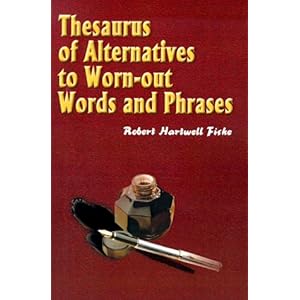
Thesaurus of Alternatives to Worn-Out Words and Phrases **

** Thesaurus of Alternatives to Worn-Out Words and Phrases, Robert Hartwell Fiske, 1994


My mom got this for me at a garage sale or some such a year ago. I gave it the upstairs bathroom position, reading the 310 pages in two or four page chunks.

I mainly skimmed through the phrases to keep fresh in my mind what not to use. After the first few pages, I didn't read much of the alternatives copy.

It's good to remind yourself occasionally of the cliches and tired terminology you use without thinking of it, so you can toss that out and create something fresh. However, Fiske's tone is snobbish, with didactic pronouncements such as:

Infantile phrases are popular among adolescents--and dimwits who still think like them.
Ineffectual phrases add only to our being ineffectual people.
If it weren't for our plethora of metaphors, especially sports images, dimwitted men and, even women would be far less able to articulate their thoughts. 

Hence the skimming. I can use the list without the condescension.


October 4, 2012

Regarding Ducks and Universes **

** Regarding Ducks and Universes, Neve Maslakovic, 2011


Clever idea, the ability to travel as a tourist between parallel universes where your doppelganger resides, and the myriad regulations to prevent you from interfering with your alter ego or disrupting the space-time continuum. And the protagonist is a technical writer. What's not to like?

For me, that would be a passive protagonist. Despite the rules, Felix A wants to learn more about his alter. He checks a bookstore to see if Felix B has already written the book Felix A plans to write, and then goes to a detective agency to have them investigate Felix B. Then he his promptly locked up in quarantine and the forward momentum of the story grinds to a halt. Once he gets out, in a plot point that would take too long to relate here, he falls under the control of an investigative team and the action is driven by others, not the protagonist, for the large majority of the book.

That's not a satisfying story. I much prefer a pro-active protagonist who actively pursues his goal and overcomes obstacles. But it is a clever idea with some bright spots.


August 2, 2012

They Eat Puppies, Don't They? **

** They Eat Puppies, Don't They?, Christopher Buckley, 2012

I went to see Buckley at a signing sponsored by the LBJ Library and the Texas Book Festival. He was clever and articulate, as always. Despite my recent change of heart regarding Buckley, I picked up a copy for signing to pass on to the one who turned me on to Buckley. But I read it first. ;-)

It's classic Buckley, timely, funny, sarcastic, and superficial. It's the last one that has caused me to go off my feed when it comes to Buckley novels. If you haven't read any Buckley, you should definitely give him a shot. At least two or three.


July 19, 2012

A Paramedic's Story: Life, Death, and Everything in Between **

** A Paramedic's Story: Life, Death, and Everything in Between, Steven Kelly Grayson, 2010

I picked this up when I first got the Kindle and dropped back to it when I was between books. It isn't a particularly well-written book and it is occasionally crude, but it has a lot of heart. Funny anecdotes and heart-breaking stories that span the career of a paramedic in Louisiana.

It's a good book to dip into occasionally. I don't think I would have liked it as much if I went straight through it in a few sittings.


June 21, 2012

Little Dorritt **

** Little Dorrit, Charles Dickens, 1857

Bless me father, for I've been reading Dickens. It's been three years since my last novel.

Giving Dickens two stars out of four feels like cussing in church, but after looking over the review I gave Our Mutual Friend in 2009, I should have had the guts to give it two stars, also. I don't know if my tastes have changed dramatically from twenty years ago when I gave Great Expectations and David Copperfield four star reviews, or if these two more-recently-read-but-lesser-celebrated novels are that dramatically different from those two classics.

I enjoyed the BBC production of Little Dorrit so much, especially Andy Serkis's portrayal of Rigaud, that I grabbed a (free and pitifully formatted) copy of it for my Kindle last year. Clocking in at 334,000 words, it was clear that Dickens was being paid by the word and after five or ten hours of slogging through it, I was feeling every bump in the road and I was barely a third of the way through.

The book is divided into two sections, Poverty and Riches. I took a several-month break between the two to get my strength back up to finish it.

That's not to say there is no brilliance in Little Dorrit. To the contrary, there is quite a bit of it, particularly the satire of the Circumlocution office. But like the modern US welfare system, of which Dickens would doubtlessly have been a supporter, the novel seemed to suffocate under its own weight.

For example, the character of Flora Finching was humorous due to her intense case of logorrhoea, but it was illustrated through passages of borderline-indecipherable monologue that went on for pages. After a while the amusement fades and you just have to start skimming.

Mea culpa, but there it is.

June 14, 2012

Spider Dance **

** Spider Dance, Carole Nelson Douglas, 2004

In the final (as far as I know) novel of the series, Irene stays in New York on a mission to unearth the truth about her origins, particularly her mother.

On the upside, we have the full cast of characters we have come to know and love (excepting Watson), historical and fictional, and a gruesome murder in the Vanderbilt mansion to solve.

On the downside (for my reading tastes), in Irene's search for her mother, we have a seriously degraded SNR, pages and pages of interviews with various characters about what they remember, copious pages of declamation on women's rights and gender roles and social mores. And interspersed with the story we have an alternate narrative of an unnamed "dangerous woman" four of five decades earlier.

The issue for me is that I'm reading this series solely because it's an extension of the Holmes canon and involves a clever interpretation of an interesting character from that canon. As such, I'm looking for a mystery story and these other things, however well written they may be, are of no interest to me. But that is a creative decision that right belongs to the author, as it should. It just means that I am not the target audience for the last few books in the series. But I wish Ms. Douglas great continued success with her books

June 7, 2012

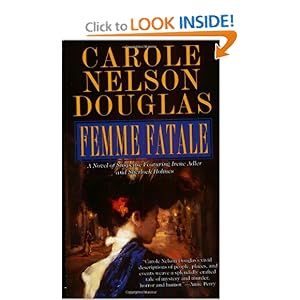
Femme Fatale **

** Femme Fatale, Carole Nelson Douglas, 2003

In the (to my knowledge) penultimate Irene Adler story, The Woman returns to her roots, America, drawn by a meddling Nellie Bly. People from her mostly forgotten childhood are dying by the cartloads and three people are on the case, working independently, Adler, Bly, and Holmes.

I loved the first few Irene books, but the further I go into the series, the lower the SNR (story to noise ratio) drops. By noise I mean things that don't move the story forward, such as discourses on fashion or religion or gender roles or women's rights or pages of banter between characters or back story relating what happened in previous books.

You expect some of this in the way of establishing character or sense of place or other of the little things authors do to keep a novel from turning into a screenplay. And to be sure, there is a certain amount of personal taste involved in determining the proper SNR, but I have a fairly liberal meter, as anyone who has read my novels knows.

But when you go twenty or more pages in a detective novel without anything of significance happening, the SNR is dangerously low.

So I've taken to skimming, which is practically against my religion. This saddens me because of how much I wanted to like the whole series as much as I liked the first few books. Oh well.

January 19, 2012

A Toast to the Holy Ghost? **

** A Toast to the Holy Ghost?, Kelly Libatique, 2010

I grabbed this one on Kindle after noticing some (possibly coincidental) similarities in the description and my 1996 essay on the topic. I read through it in a night and found it worthy in places, but laden with specious reasoning in others. For example, consider this passage:

"It is interesting to note that God knew perfectly well when inspiring the authors of the Bible that using an ambiguous word here (and in many other places) would cause centuries of debate. If He had wanted to make it clear one way or the other, He could have easily done so."

Am I to conclude from this passage that God knew his ambiguity would cause confusion and intentionally created ambiguity for that purpose? This sounds suspiciously like the "God placed dinosaur fossils in the earth to give the appearance of age" argument of creation over evolution. This and other similar issues left me feeling the book was less than helpful.

My take on the topic: WWJD

January 12, 2012

Wine in the Bible **

** Wine in the Bible, Samuele Bacchiocchi, 2001

This is an exhaustive study of the subject from multiple viewpoints, delving down into the Hebrew, Greek and Latin with hundreds of footnotes, written by a Seventh-day Aventist theologian in his sixties. This book was a clear indication to me how just how superficial my analysis was. It is also a highly soporific approach and I am certain that the casual inquirer into the subject will never get past the 3 prefaces, the 8-page introduction (legal pages) and the 9-page second introduction. Chapter 1 shows up at page 28

Bacchiocchi proclaims at the outset to adopt a prohibitionist stance. I found a lot of the examination of the original language to be enlightening and worthy of reflection, but the ad hominem attribution of ulterior motives to scholars who translated things differently weakened his credibility, especially when he evinced the same propensities himself. In addition, in the problem passages and elsewhere there seemed to be a significant amount of begging the question.

All that notwithstanding, for a serious student of the issue it's worth a read for the analysis of the original language alone. Just keep your logical fallacy filters on high.

My take on the topic: WWJD

January 9, 2012

Spytime **

** Spytime: The Undoing of James Jesus Angleton, William F Buckley Jr, 2001

Being a big fan of Buckley's Blackford Oaks spy novels, I decided to give this book a whirl. Angleton was the head of CIA counterintelligence from 1954 to 1975 and Spytime is a novel based on Angleton's career. It's been almost two decades since I read a Blackford Oaks novel so I could be wrong, but I recall them as being more engaging than Spytime. It's a decent enough read, but not something I found myself dying to get back to.

Halfway through the book a b-story starts, featuring one of Angleton's operatives and almost nothing of Angleton, and goes on for 120 pages (over a third of the book) before it is rather abruptly cut off 40 pages from the end of the book. I found that a little annoying.

But if you're a fan of spy novels, or of history, this might be the book for you.

December 19, 2011

Cannibal Nights **

** Cannibal Nights: Pacific Stories, Volume II, Kiana Davenport, 2011

I bought this Kindle book and House of Skin three months ago in response to the storm of controversy that Davenport fell prey to in the clash of the old guard (traditional publishers) and the new guard (ebook self-publishing). I won't go into the various sides of the fracas, but there are probably points of merit in both camps, although I tend to side with the author, for obvious reasons.

I haven't read her previous, traditionally-published, work, but the endorsers include Alice Walker (The Color Purple), Isabel Allende (15+ novels, 30+ awards), Norman Mailer (need I say more?), The Washington Post and The Chicago Tribune. Despite the very amateurish cover that screamed SELF PUBLISHED!!! I grew hopeful.

As the title suggests, Cannibal Nights is a collection of short stories. I'm more of a fan of the long form, although I have thoroughly enjoyed many short story collections, including those of Damon Runyon, P.G. Wodehouse, G.K Chesterton, O'Henry, Flannery O'Connor, and others. Aside from the last, not necessearily literary, perhaps.

While I found Davenport's writing engaging in spots and well crafted in others, I was disappointed. In many cases I felt like I was getting a story in summary, rapidly glossing through the high points with the occasional dip into an immediate scene, which failed to pull me into the narrative and connect with the characters. There were moments in George Bush and Papa at the Paradise that I enjoyed, and some of the title story, but often I felt the plot of the stories to be ennervatingly inevitable, cloyingly melodramatic, or tritely tragic.

Given the endorsements, I suspect that her other work is more compelling. We shall see what House of Skin brings us.

EBOOK FORMATTING *

Why it matters.

Unfortunately, the formatting of the ebook was as amateurish as the cover. Absolutely zero navigation from the Kindle menu, although there is a TOC near the front. To get to it, you have to navigate to the cover and page forward ten pages or navigagte to the beginning and page back four pages. No logical TOC, no left/right button navigation between stories, which means she didn't create a toc.ncx file.

Vertical spacing is formatted via blank linespaces, so when you scroll between TOC items, you have to scroll through the blank lines as well.

Chapter headings are formatted with the anchor inside the heading tag, which means that the heading loses its formatting when navigated to via the TOC rather than the next-page key.

Paragraph formatting and scene changes are formatted properly.

I wish Davenport well, but if she's going to self-publish, should step up to the plate and either learn the technology or contract it out to a competent freelancer. And get a real graphic designer to do the cover.
August 4, 2011

The Art of War **

** The Art of War, Sun Tzu, 512 B.C.

One advantage of getting a Kindle is you end up reading all the classics you've been putting off reading because you can get them for free. One downside of this practice is that the free versions tend to have poor formating. But hey, it's free.

One thing I learned in the (very long) introduction is that, like the Bible, The Art of War has had many translators with varying interpretations of problem passages. Lin Wusun's translation is interspersed with James Clavell's commentary, which offers alternate translations and illustrative anecdotes.

If I were a student of war, strategy and tactics, I would have found the multiple viewpoints interesting, but I'm not and I found they slowed down the reading. However, I did enjoy the anecdotes. Man, those ancient Chinese warriors were a crusty lot!

If you're into this type of thing, it's worth more stars. For me it's more of a curiousity than anything. Hmm, maybe I'll stream the Wesley Snipes movie of the same name.

July 28, 2011

American on Purpose **

** American on Purpose, Craig Ferguson, 2009

My Tue-Sat morning routine is to grab the iPad and watch the previous nights Late Late Show while I make and eat breakfast. In my humble but accurate opinion, he's the only late night talk show guy worth watching.

So I put his biography on my BoxedUp list and ended up with two copies at Xmas. I rated it as two stars not because it's bad. It's an interesting read and well written, but not a must-read by any stretch. But if you're a CraigyFerg fan, it's worth picking up.

July 21, 2011

No Way to Treat a First Lady **

** No Way to Treat a First Lady, Christopher Buckley, 2003

Could it be that I'm over Buckley? I have found the last two clever, but no longer engaging. Erudite, sophisticated, but no heart. Well, one must eat the chicken and spit out the bones. I'll keep sampling and see if things change.

May 26, 2011

Little Green Men **

** Little Green Men, Christopher Buckley, 1999

My Buckley source told me that Little Green Men was the best. I finally picked up a copy and found that I must respectfully disagree. Like other Buckley novels, it is zany and erudite, but I felt like I never got below the surface on any of the characters, not even the protagonist. A lot of the character reactions seemed contrived or obvious, as if Buckley was taking the easy way out, almost phoning it in.

Also, I found one mistake. A UFO convention is set in Austin and the protagonist looks down from his high-rise hotel across Lake Austin. The problem is that the portion of the Colorado River that runs through town was called Town Lake at the time. Now it's called Ladybird Lake. Lake Austin is further west.

February 3, 2011

John Gardner: Literary Outlaw **

** John Gardner: Literary Outlaw, Barry Silesky, 2004

I've taken to reading biographies on the elliptical, and it's worked out fairly well. I picked up this bio years ago because of one Gardner book, Grendel. As I mentioned in my review of The Art of Fiction, Grendel is a short little book with a very large punch. Beyond that, all I've read of Gardner are his two books on the writing life, On Becoming a Novelist, and the writing craft, The Art of Fiction, both very worthy books that any aspring or accomplished writer should own.

The only other bit of his fiction I've attempted to read is Nickel Mountain, but even after repeated attempts I couldn't get past the first few chapters.

I learned from this bio by Silesky that Gardner was talented, brilliant, witty, gregarious, and relentlessly driven to write. Also that he was a womanizing, arrogant, bombastic lush. He seemed like someone who would be fun to be with at a party, but sheer hell to live with or depend on for anything besides writing.

The bio would be interesting for anyone interested in the man and his work, but I would recommend you just pick up a copy of Grendel and read it instead. Anybody need a copy of a John Gardner biography?

December 23, 2010

The Sign of the Book **

** The Sign of the Book, John Dunning, 2005

I hate to say it, but this Cliff Janeway didn't stand up to the rest of the franchise. At least not for the first 150 pages. Cheesy on-the-nose dialog, tedious exposition-laden backstory with cheap emotion, and utilitarian scenes that tell us what we already know or drag on too long dominated the first quarter of the book.

It finally took off when Janeway staked out the house on the mountain and followed the guys he found there, but it lacks the sophisication of his earlier efforts. If you're going to read the Janeway novels, and I suggest you start at the beginning.

December 2, 2010

The Road **

** The Road, Cormac McCarthy, 2006

As you know, this book won the 2007 Pulitzer Prize for Fiction and the James Tait Black Memorial Prize for Fiction in 2006.In 2010 the London Times ranked The Road first on its list of the 100 best fiction and non-fiction books of the past 10 years.

That's nice and everything, but I never really got McCarthy. I read All the Pretty Horses in the 90s and didn't get it, either. I guess I'm not sophisticated enough for critically acclaimed stuff. He's often compared to Faulkner, who I also don't get.

The writing was good, but the story didn't grab me. Well, it did, at first, but after a couple hundred pages of a man and a boy walking through a post-apocalyptic wasteland, looking for food and encountering 3 or 4 other humans during that span, I had gotten enough to last me for the next decade.

If you're the type who loves McCarthy, great. Enjoy it. I'll enjoy something else.

November 25, 2010

Levi's Will **

** Levi's Will, W. Dale Cramer, 2005

I got this book a long time ago because Cramer was chewing through the Christy awards. I thought Bad Ground was OK, but everyone was raving about Levi's Will, so I had to check it out. It's a decent book, but too much front-loaded back story, exposition and on the nose narrative for my liking. YMMV.

November 4, 2010

Something Nasty in the Woodshed **

** Something Nasty in the Woodshed, Kyril Bonfiglioli, 1979

Yet another entry in the Books Sent To Me By The Learned One series. Total change of venue from the first two in the trilogy. Set on the Isle of Jersey with the story line moving from international crime and intrigue to trying to catch a brutal serial rapist who is using pagan/satanic paraphenalia/symbols. The bulk of the story is taken up with a bizarre scheme to hold a black mass to intimidate the bad guy into stopping. Then, at the end, it just blows up.

Bonfiglioli has an entertaining style, but no clue about story structure.