-->

July 26, 2012

The Sins of the Fathers ***

*** The Sins of the Fathers, Lawrence Block, 1976

In my not-so-humble but quite accurate opinion, if you have a chance to read through a Lawrence Block novel, do it.

This is the first Matthew Scudder novel, written in 1976. It features a sparse, almost journalistic style with little inner monologue. All dialog and action. I liked the story, but found myself yearning for a little peek into Scudder's psyche.

Like A Confederacy of Dunces, this novel was written before political correctness took over and it's interesting to see the contrast with modern attitudes.

In addition to his novels, Block wrote books on the craft and a column in Writer's Digest for many years (which was picked up by James Scott Bell). He's over 70, but on the cutting edge of the ebook revolution. Gotta love that.

July 19, 2012

A Paramedic's Story: Life, Death, and Everything in Between **

** A Paramedic's Story: Life, Death, and Everything in Between, Steven Kelly Grayson, 2010

I picked this up when I first got the Kindle and dropped back to it when I was between books. It isn't a particularly well-written book and it is occasionally crude, but it has a lot of heart. Funny anecdotes and heart-breaking stories that span the career of a paramedic in Louisiana.

It's a good book to dip into occasionally. I don't think I would have liked it as much if I went straight through it in a few sittings.


July 12, 2012

Nothing to Hide ****

**** Nothing to Hide, J. Mark Bertrand, 2012
Third in the series after Back on Murder and Pattern of Wounds, Nothing to Hide stands out as Bertrand's best work, yet. Aging and beleaguered, Detective Roland March might actually be out on his ear this time.

An occasional bounce into March's 1986 career as an MP allows the reader to converge on the identities of two key players in the current story crime.

Reading the previous two reviews will quickly let you know that I consider Bertrand's Roland March series a must-read. I had only minor, insignificant quibbles with the first and no reservations about the second. I don't speak lightly when I say that if you like Connellys' Harry Bosch series, there's a very good chance you'll like Bertrand. I read a lot of whodunits and I can't think of another I would say that, with the possible exception of Riordan's Tres Navarre series.

Like Connelly, Bertrand holds nothing back. You can make no assumptions and no one is safe. You get the feeling he'll kill of March if it serves his purpose, or render him irrelevant. A writer like Bertrand can pick up with another protagonist and off we go again. Not that I'm suggesting I've had enough of March. Quite to the contrary.

I haven't asked Bertrand if he has any other March novels under contract because I'm afraid of hearing the wrong answer. But if there's any fairness in this world, and that's a highly dubious speculation, then we're in for many more years of Roland March goodness.

In the meantime, catch up. You don't want to be behind when the next one comes out.


July 5, 2012

The Last Four Things ***

*** The Last Four Things, Timothy Hallinan, 1989

I discovered Hallinan on DorothyL.com, an email list for fans of detective fiction. This book is the first in the Simeon Grist series and a good start. It's a first-person novel and I like the voice of the protagonist, not quite hard boiled, but plenty tough while being somewhat cerebral. It's a good story with plenty of action and plenty of depth and I enjoyed the ride.

Here are a few quotes I picked out:

His fingers groped toward each other and met again over his stomach like five overweith pairs of illicit lovers on safe ground at last.
They were obviously ready to protect that wet red carpet with their lives, if the need arose. The one on the right had the kind of face that suggested that he hoped the need would arise, and sooner rather than later: fat, downturned lips, a short thick pug nose, and two stupid little eyes lurking close together under a bony brow-ridge that I thought had been eliminated from the gene pool several million years ago. The other one just looked dumb. 
I have only one quibble, a topic I brought up in a previous review, the SNR (story-to-noise ratio). In several places the action comes to a stop for lengthy discussions of topics that are relevant to the mystery at hand but that do not support the forward momentum of the narrative, conversations between characters about religion or philosophy or other things. Hallinan is an excellent writer and put together a fine series opener, but in my not-so-humble-but-always-accurate opinion it would have been better served by whittling these tangents and streamlining the story.

That being said, it's still worth reading, and I'll be continuing in the series. Give it a shot.

July 3, 2012

Neil Gaiman on writing for money

An excerpt from a commencement address by Neil Gaiman:


I decided that I’d do my best in future not to write books just for the money. If you didn’t get the money, then you didn’t have anything. And if I did work I was proud of, and I didn’t get the money, at least I’d have the work. –Neil Gaiman
 It's 20 minutes of astoundingly good, and amusing, advice for those who create. Make good art.

July 1, 2012

Living with Fred and Exploding Eggs

Update Aug 1, 2012: The author of the email described below is also the author of the amazing book, Help Me Be a Good Girl Amen. I stayed up past 4am reading it. You can read a sample at the link.

One of the best things about being published is hearing from readers. The reviews for Muffin Man are all entertaining to read, even the the two-star reviewer who claimed it wasn't as engaging as Russo's Pulitzer-prize-winning Empire Falls (in my dreams!) and who ended the review with:
I going out to eat a donut now. bye
Which I took indicate that the muffin may have had  a greater impact on him/her than he/she thought.


And nothing tops the review from IZONPRIZE that opens with:
Brad Whittington had me dedicated to the final page, from Day 1 like a momma chimpanzee looking for fleas on her only child.
But a recent email has the most unusual story associated with reading my books that I've received to date.  


Here's an excerpt.
My eyesight is pretty bad, since I am now 86, so my daughter bought me a Kindle and I get to read anything that she has loaded in. I am REALLY enjoying the Fred stories.

I appreciate your rich vocabulary, which you use so extravagantly. I suspect a lot of folks don't know what treasures you draw from.

I was getting such a kick out of your story this afternoon that I forgot I had put five eggs on to boil, and didn't remember them till they started exploding. After the third shot-egg blast I got up and found egg parts all over the kitchen, and a horrible stink besides.
But -- so -- on with the book. Thanks so much for writing the way you do.
If I wasn't already driven to write incessantly, emails like this one would do the trick.


Keep those cards and letters coming.

June 28, 2012

The Last King of Texas ****

**** The Last King of Texas, Rick Riordan, 2001
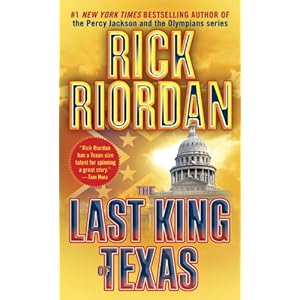
Although I think I've read everything Rick has written, to date I've only reviewed one other Tres Navarre novel, The Devil Went Down to Austin. Not for lack of love, but because when I was reading the other books, I wasn't writing reviews. I come back to The Last King of Texas pursuant to a character I'm developing for my next novel, a dealer in arcade and casino games for the greater southwest region. As it turns out, there's not a lot in common between my character, Buckworth, and Riordan's Del Brandon, carnival ride dealer down in San Antonio.

But any minute reading a Tres Navarre novel is not wasted, regardless the motivation or outcome. This is actually the first Riordan novel I ever read, having discovered it while living in Honolulu. I mean, how can you pass up a novel with this title? I immediately went back and got the first two and moved on from there.

I've had the chance to meet Riordan on three or four occasions, the first being when I took a half-day workshop he taught on writing a mystery novel, just before the first Percy Jackson book came out. Extremely nice guy.

I dare anyone to read the first chapter of this book and set it down and walk away. I can't imagine the person who could do such a thing. Well, there's my son-in-law, but nobody else. I would give you some quotable lines, but there are dozens in every chapter, so I lost track.

Look, forget all that. Just go out and get the dang book and read it. Okay?

Oh, and Rick, I know you're busy writing best-seller YA novels left and right, but hire someone to be-Kindle your Tres Navarre backlist. Just do it.

June 21, 2012

Little Dorritt **

** Little Dorrit, Charles Dickens, 1857

Bless me father, for I've been reading Dickens. It's been three years since my last novel.

Giving Dickens two stars out of four feels like cussing in church, but after looking over the review I gave Our Mutual Friend in 2009, I should have had the guts to give it two stars, also. I don't know if my tastes have changed dramatically from twenty years ago when I gave Great Expectations and David Copperfield four star reviews, or if these two more-recently-read-but-lesser-celebrated novels are that dramatically different from those two classics.

I enjoyed the BBC production of Little Dorrit so much, especially Andy Serkis's portrayal of Rigaud, that I grabbed a (free and pitifully formatted) copy of it for my Kindle last year. Clocking in at 334,000 words, it was clear that Dickens was being paid by the word and after five or ten hours of slogging through it, I was feeling every bump in the road and I was barely a third of the way through.

The book is divided into two sections, Poverty and Riches. I took a several-month break between the two to get my strength back up to finish it.

That's not to say there is no brilliance in Little Dorrit. To the contrary, there is quite a bit of it, particularly the satire of the Circumlocution office. But like the modern US welfare system, of which Dickens would doubtlessly have been a supporter, the novel seemed to suffocate under its own weight.

For example, the character of Flora Finching was humorous due to her intense case of logorrhoea, but it was illustrated through passages of borderline-indecipherable monologue that went on for pages. After a while the amusement fades and you just have to start skimming.

Mea culpa, but there it is.

June 14, 2012

Spider Dance **

** Spider Dance, Carole Nelson Douglas, 2004

In the final (as far as I know) novel of the series, Irene stays in New York on a mission to unearth the truth about her origins, particularly her mother.
On the upside, we have the full cast of characters we have come to know and love (excepting Watson), historical and fictional, and a gruesome murder in the Vanderbilt mansion to solve.

On the downside (for my reading tastes), in Irene's search for her mother, we have a seriously degraded SNR, pages and pages of interviews with various characters about what they remember, copious pages of declamation on women's rights and gender roles and social mores. And interspersed with the story we have an alternate narrative of an unnamed "dangerous woman" four of five decades earlier.

The issue for me is that I'm reading this series solely because it's an extension of the Holmes canon and involves a clever interpretation of an interesting character from that canon. As such, I'm looking for a mystery story and these other things, however well written they may be, are of no interest to me. But that is a creative decision that right belongs to the author, as it should. It just means that I am not the target audience for the last few books in the series. But I wish Ms. Douglas great continued success with her books

June 7, 2012

Femme Fatale **

** Femme Fatale, Carole Nelson Douglas, 2003

In the (to my knowledge) penultimate Irene Adler story, The Woman returns to her roots, America, drawn by a meddling Nellie Bly. People from her mostly forgotten childhood are dying by the cartloads and three people are on the case, working independently, Adler, Bly, and Holmes.

I loved the first few Irene books, but the further I go into the series, the lower the SNR (story to noise ratio) drops. By noise I mean things that don't move the story forward, such as discourses on fashion or religion or gender roles or women's rights or pages of banter between characters or back story relating what happened in previous books.

You expect some of this in the way of establishing character or sense of place or other of the little things authors do to keep a novel from turning into a screenplay. And to be sure, there is a certain amount of personal taste involved in determining the proper SNR, but I have a fairly liberal meter, as anyone who has read my novels knows.

But when you go twenty or more pages in a detective novel without anything of significance happening, the SNR is dangerously low.

So I've taken to skimming, which is practically against my religion. This saddens me because of how much I wanted to like the whole series as much as I liked the first few books. Oh well.