-->
Showing posts with label *. Show all posts

February 16, 2012

Cracking the Wine Case: Unlocking Ancient Secrets in the Christian and Drinking Controversy *

* Cracking the Wine Case: Unlocking Ancient Secrets in the Christian and Drinking Controversy, Scott E. Smith, 2010

The thing that disturbs me about this book is that it purports to be an unbiased examination of the scriptures to find what the Bible says. But every chapter starts with a quote about the evils of alcohol and it takes over 100 pages before it gets to actually examining the scriptures. The first seven chapters stack the deck before we get there.

  • Introduction: Stories about how alcohol abuse destroyed the family of a childhood friend and how God saved him from alcohol through a childhood experience.
  • Chapter 1: Story about a drunk driver who killed someone. Story about arguing his case in a Bible study that met in a bar. Long section addressed to those with alcohol addiction.
  • Chapter 2: Story about how Martin Luther was right about a lot of things but dead wrong about drinking.
  • Chapter 3: Compares drinking to porn, snake venom. Quotes from AA that the only safe way to drink is to not drink at all. Negative, medical facts. Analyzing motives of those who drink. Admonitions that God can set you free from a distorted lifestyle of drinking.
  • Chapter 4: Calls preachers who advocate drinking "wolves in the pulpit."
  • Chapter 5: Compares drinking to premarital sex, LSD, meth, cocaine. If you love God, you will do want he wants, which is to not drink.
  • Chapter 6: Different words for wine in the bible.
  • Chapter 7: History of fermintation techniques.

All of this before we actually examine what the Bible says in Chapter 8. By now he's lost credibility with me because of this whole sandbagging technique. As far as looking at the verses, it's nothing I haven't already read in the other books, although once again there are discrepencies with how other abstainers interpret things.

For example, some say Paul told Timothy to take wine to kill the bacteria. Others say there is no evidence for this and people who say that are distorting the scriptures, that it is well known that wine is not good for for your stomach, and obviously in this case oinos meant grape juice.

If there were any doubt about this being a dispassionate study, chapter titles such as "Jesus the Miraculous Bartender" (referring to the miracle at the wedding at Cana) remove any doubt. This chapter is also a good example of the creative explanations that these guys seem compelled to come up with.

This book treats all drinkers as if they are alcoholics and in some places outright says that anyone who takes one drink will eventually become an addict and have his life destroyed. This is clearly not true and compromises the credibility of his other statements. To be fair, Smith's viewpoint might be colored by the fact that he has a prison misistry to addicts whose lives have been destroyed by alcohol. But not everybody who drinks wine ends up a drunk. That's just a fact and this book does a disservice by claiming otherwise.

My take: WWJD

February 2, 2012

The Biblical Approach to Alcohol *

* The Biblical Approach to Alcohol, Stephen M. Reynolds and Calel Butler, 2003
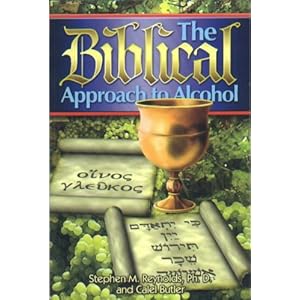
These books are starting to wear on me. That's the danger of reading books by preachers. They have no interest or experience in expressing an idea with an economy of words. In addition, this book needs a good going over for organization. It seemed to be a list of vignettes thrown down as Reynolds thought of them in random order, which made it more difficult to build a solid understanding of the larger picture.

But there were several things that stood out for me and made me think, "You're serious about this? Really?" How about this quote:

"God left a number of things somewhat difficult to perceive as a test of spiritual perception of Bible readers. [Section about Jesus being the Messiah.] In the same way God may have left His true teaching concerning alcoholic beverages with what the undiscerning find to be ambiguities. This may have been with the view of separating the spritually perceptive (those whose ears are attuned to the true testimony of the Holy Spirit) from those whose perceptions are made dull by some sin which they cherish. Such a separation of those who take advantage of paradoxes in order to indulge their fleshly appetites may be used by God in judging man."

Really? You're saying God intentionally inspired an ambiguous message on alcohol so he could jerk believers around as a test to see who is really serious? Here's another passage 80 pages later:

"He may have left the teaching concerning the command to total abstinence somewhat obscure as a test to determine who among those who profess to believe in Him would discern His true meaning. Some, understanding that alcoholic beverages are a Christian liberty, overindulge themselves to the point of total ruin; others become soft and flabby in their Christian warfare; others who are teachers of religion mar their record by giving the people who follow them bad instruction. In the end God accomplishes His purpose of sorting wheat from chaff, and in grading how much each servant made from his talent, or talents."

God uses intentional ambiguity on the subject of alcohol to separate the wheat (saints) from the chaff (damned)? This gets even more absurd when, as we see later, that even people who agree on total abstinence disagree on the meaning of specific uses of the original language. And notice the repeated use of "may" in both passages, which leads me to the next complaint.

While these books frequently make good points, many of them don't seem content to leave it at that, but seem compelled to descend into speculation to drive the point home.

For example, regarding the miracle at Cana, Reynolds speculates that Jesus and Mary arrived late, and that unlike Mary, Jesus perceived that the crowd was drunk. He says this explains why Jesus reacted with outrage when Mary suggested he help out the steward with his wine problem. He also speculates that Jesus left quickly after creating 180 gallons of grape juice because he wouldn't hang out around drunk people.

Honestly, how can you take a book seriously when the author just makes up crap out of whole cloth and presents it straight-faced alongside serious research into the original languages? It destroys any credibility that might be left after the "God is jerking you around" statement.

I readily admit in WWJD that I'm no Biblical scholar and can't research back to the original languages. However, Bacchiocchi and Reynolds are Biblical scholars, so I paid attention to their exposition on the original words. I learned that there are two Hebrew words translated to wine in the OT, tirosh and yayin and one word in the NT, oinos. There one word translated to strong drink, shekar.

From Bacchiocchi I learned that tirosh always means grape juice. This was foundational to his position. On the other hand yayin and oinos sometimes mean grape juice and sometimes wine, depending on the context. And shakar always means fermented drink, except in one passage where it would be inconvenient if that were the case, so in that passage it means grape juice. He goes to great lengths and many pages to talk his way around this one exception, even though it seemed to me, the complete doofus in Hebrew I admit, that it was more handwaving than substance.

On the other hand, from Reynolds I learned that all of the words, tirosh included, can mean either wine or grape juice. The fact that tirosh could swing either way was very important to his point. So I'm left thinking, if these two scholars can't figure it out, what hope do I have of coming to a solid conclusion based on the original languages? Is God really going to judge whether I'm wheat or chaff based on whether I figure out what these two scholars can't agree on?

These two also seem to enjoy engaging in circular reasoning, which occurred repeatedly in both books. One example goes like this:

  1. We will search the original language to see what is the attitude of the Bible toward drinking fermented (alcoholic) drinks.
  2. In the original language, tirosh always means grape juice (or doesn't necessarily, if you're Reynolds) and always is used in positive references.
  3. In the original language, yayin sometimes means wine and sometimes grape juice. You can tell which by the context. If it's a negative reference, yayin means wine. If it's a positive reference, yayin means grape juice.

You see the problem here? In step three we have the problem of deciding which references mean wine. We solve that problem by assuming that if the reference is negative, it means wine. But that is begging the question, assuming the thing we're trying discover, which is what is the attitude of the Bible toward wine. So the exercise is completely useless.

Overall, there were some diverting sections, but much of the book was less than helpful. And, like Bacchiocchi, Reynolds takes a lot of space to talk about medical implications and social issues and several other things that have nothing to do with the scriptural position.
July 14, 2011

The Hawkline Monster *

* The Hawkline Monster, Richard Brautigan, 1974

I'll give you the good stuff first. Several good turns of phrase and it was short, so I didn't waste that much time reading it.

I don't remember who recommended this book to me, so I can't hunt them down and thrash them severely about the head and shoulders with it. Plus, it probably wouldn't do any good, anyway since it's a lightweight paperback.

I've been familiar with the name because of the book Trout Fishing in America, but never read any of his stuff. Based on this sampling, I won't read another anytime soon. The cover blurb says The Hawkline Monster is "by far the best-selling of any of Richard Brautigan's books." OK.

While there is the occasional serendipitous turn of phrase, such as "[she] slipped like a grape peeling off her horse and into the arms of the woman," most of the writing was unremarkable. Much more telling than showing. Weird and quirky things seemingly tossed in randomly to artificially inject interest. Development of a whole plot line that is abandoned without explanation. Using the ability of the monster to manipulate thoughts to inject gratuitous, unmotivated sex. Random complications shoehorned in to delay forward momentum, evidently to build suspense, unsuccessfully, in my case.

And, when you come down to it, just a dumb storyline. Perhaps I'm a philistine, but I'm not seeing the genius, here.

October 14, 2010

The Island of the Day Before *

* The Island of the Day Before, Umberto Eco, 1994

It really, really, and I mean really, pains me to give this book one star. I loved his first two novels, The Name of the Rose (1983) and the resulting movie with Sean Connery and Matthew Broderick, and the ultimate consipracy theory novel, Foucalt's Pedulum (1989).

I snagged this monstrous 500+ page volume years ago and have hauled it around on various moves. I finally broke down and subjected it to the Elliptical Test. It failed miserably.

The issue is that there is no plot. Eco is a brilliant writer, but not even he can sustain my interest for 513 pages without a plot. I read to page 257 and skimmed the rest to verify my suspicion. It's a sad day in Mudville.

May 8, 2008

The Shack *

* The Shack, William P. Young, 2007

It had to happen sometime. Our first one-star review of the year. I knew going in I wouldn't like this book, but I got it as a birthday present with the comment, "I'd like to hear what you think about it." So what choice did I have? I may be a jerk, but I'm not a complete cad. Yet. Give me time. I have a few years left in me. I might make curmudgeon of the year before it's over.

Lots of people love this book. Lots of people read People magazine. I'm not one of them, in either case. I'm not saying there's a correlation, here. Just mentioning some specifics.

Here's my problem with this book. It's a cheesy, schmaltz-laden story wrapped around a lecture on the nature of God.

If I want to read a good story, I want some really good writing. Life is too short to endure mediocre writing. Not everybody is as picky as I am. That's fine. Let them read what they like, and I'll do the same.

If I want to read a book on the nature of God, then I want a book that deals with the subject directly, not a 250-page third-rate parable with an angst-ridden character tossing softball questions to a sagacious character to hit out of the ballpark. Or three sagacious characters, either.

Actually, I got through the Foreword and thought, "Maybe I was wrong. Maybe this is a good book after all."

The Foreword was the best part.

I didn't subject The Shack to the dreaded elliptical test because I knew it wouldn't stand up and during a workout is no time to be playing around with an unworthy book.

When a book repeatedly refers to The Great Sadness, just like that, in caps and italic, you know you're in trouble. Like caps wasn't enough.

We really want you to get it, reader. It's not a sadness. It's not just the sadness. Or merely the great sadness. It's not even The Great Sadness. Dammit, we're talking about The Great Sadness here! Sit up and pay attention and have a hanky or three handy.

That's not to say that there aren't some good concepts in the book. There are. I truly believe that the world would be a better place if more people embraced the concept of God presented in The Shack. Most of it, anyway. But that's not why I read books.

Your mileage may vary.